Japanese ramen is remarkably diverse not only in ingredients, but also in how it creates satisfaction.
Different styles emphasize different qualities. Some create satisfaction through volume, fat, salt, and intensity. Others focus on dashi, aroma, complexity, or balance.
None of these approaches is inherently better. They simply pursue different experiences.
|
Style |
Origin |
Main Sources of Satisfaction |
|---|---|---|
|
Jiro-kei |
Tokyo |
Volume, Garlic, Fat, Texture |
|
Iekei |
Yokohama |
Fat, Salt, Chicken Oil, Pork Broth, Soy Sauce |
|
Sapporo Miso |
Sapporo (Hokkaido) |
Miso, *Body, Aroma, Stir-Fried Vegetables |
|
Hakata Tonkotsu |
Fukuoka |
Pork Bone Flavor, Creaminess, Thin Noodles, Kaedama Culture |
|
Kitakata Shoyu |
Kitakata (Fukushima) |
Curly Noodles, Gentle Broth, Simplicity, Clarity |
|
Tokyo Dashi Shoyu |
Tokyo |
Dashi, Complexity, Aroma, Clarity, Layered Umami |
|
Wakusei |
Dashi, Layered Umami, Balance, Aroma, Broth Integration |
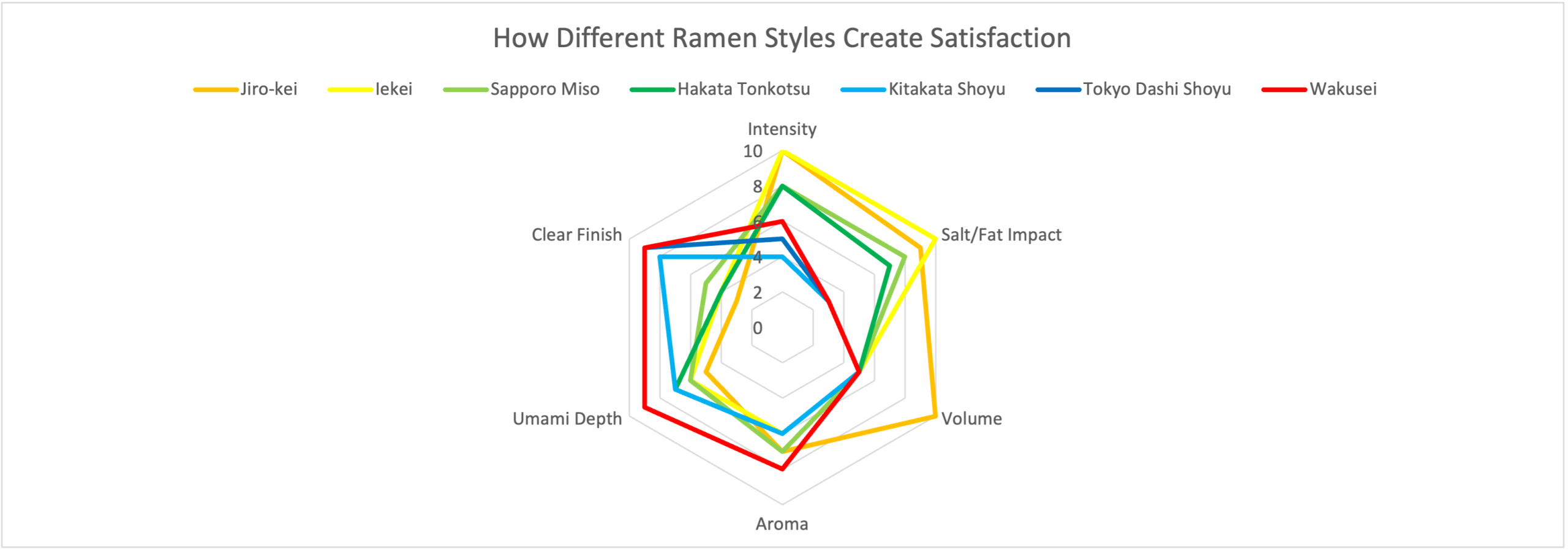
*Body refers to the sense of weight, density, and substance in the mouth.
This graph is a simplified representation of the general characteristics of different ramen styles. Specific recipes and flavor profiles can vary significantly from one restaurant to another.
The diversity of ramen comes not only from different ingredients, but also from different ideas about what makes a bowl satisfying. Understanding these differences is one of the keys to understanding ramen itself.
As shown in the previous section, different ramen styles are designed around different sources of satisfaction.
At Wakusei, we have chosen to pursue satisfaction through balance.
Rather than focusing on a single dominant element, we aim to create harmony between broth, tare, aroma oil, noodles, and toppings. We want each component to support the others rather than compete for attention.
For us, the most satisfying bowl is not necessarily the strongest one. It is a bowl that reveals new layers of flavor as you continue eating and remains enjoyable from the first sip to the last.
This philosophy influences every ramen we serve, whether it is paitan, chintan, or vegan.
Balance over intensity is not about making ramen lighter.
It is about creating depth without excess, character without heaviness, and satisfaction through the careful interaction of many elements rather than the dominance of one.
Outside Japan, house-made noodles are often seen as the mark of a great ramen shop.
While many excellent ramen shops do make their own noodles, Japan is also home to outstanding specialist noodle makers who have spent decades refining their craft. Both approaches can produce exceptional ramen.
The most important question is not who makes the noodles, but how well the noodles support the overall bowl.
Just as different broths require different ingredients and techniques, different ramen styles require different noodles.
Several factors influence how a noodle interacts with the soup:
Hydration (Water Content)
Higher-hydration noodles tend to be softer, chewier, and springier. Lower-hydration noodles are firmer and often provide a cleaner, more direct texture.
Straight vs. Curly Noodles
Curly noodles tend to catch and carry more soup. Straight noodles often provide a cleaner and more consistent interaction with the broth.
Noodle Width (Cutter Number)
In Japan, noodle thickness is often described by the cutter number (ban-te), which refers to the width of the cutting blade used to make the noodles. Different widths create different textures and influence how the noodle carries soup.
Surface Area Matters
Noodle thickness affects more than just texture.
For the same weight of noodles, thinner noodles have more surface area than thicker noodles. This means they have more contact with the broth and aroma oils, allowing flavors and aromas to be experienced differently.
However, noodle design is never about a single factor. Thickness, hydration, shape, and texture all work together to influence how a bowl tastes.
This is one reason why different ramen styles use different noodles.
For example, Sapporo-style miso ramen is often paired with thick, high-hydration curly noodles. Their strong texture helps them stand up to rich miso broths, aromatic lard, and stir-fried vegetables.
Iekei ramen typically uses medium-thick noodles designed to match dense pork-based soups, chicken oil, and strong soy sauce seasoning.
Hakata tonkotsu ramen often uses thin, low-hydration noodles that pair well with creamy pork bone broth and the kaedama (extra noodle) culture.
At Wakusei, we use low-hydration straight noodles with a #22 cutter. Their clean texture and wheat character allow the qualities of the broth, dashi, and aroma oils to remain clear throughout the bowl. We believe noodles should support the soup rather than compete with it.
Just as there is no single “correct” broth, there is no single “correct” noodle.
The goal is to find the noodle that best supports the character and balance of a particular bowl.
Noodles are one of the Five Elements of ramen. Their role is not simply to provide texture, but to work in harmony with the broth, tare, aroma oil, and toppings.
Dashi: The Foundation of Japanese Flavor
Dashi is a fundamental stock used throughout Japanese cooking.
Unlike many Western stocks, which are often built around bones, roasting, and long reductions, dashi focuses on drawing out the natural umami of ingredients with as little interference as possible.
Kombu (kelp), katsuobushi (dried bonito), shiitake mushrooms, dried fish, and vegetables are all commonly used to make dashi. Different combinations create different expressions of flavor.
Dashi is not intended to dominate a dish. Instead, it provides a foundation that supports and connects all of the other ingredients.
For many Japanese chefs, mastering dashi is one of the most important steps in understanding flavor itself.
At Ramen no Wakusei, dashi plays an important role in every bowl we serve, whether it is paitan, chintan, or vegan ramen.
The Fifth Taste
Most people are familiar with four basic tastes: sweet, salty, sour, and bitter.
Umami is often described as the fifth basic taste. The term was introduced in 1908 by Japanese chemist Dr. Kikunae Ikeda, who identified glutamate in kombu dashi as the source of a unique taste that could not be explained by the other four.
For many years, umami was primarily recognized in Japan. Later, scientists discovered dedicated umami receptors on the human tongue, confirming it as a fundamental taste.
Rather than being a specific flavor, umami creates depth, roundness, and lasting satisfaction. It is naturally found in ingredients such as kombu, shiitake mushrooms, katsuobushi, tomatoes, aged cheeses, meat, and poultry.
At Ramen no Wakusei, we use umami not to create stronger flavors, but to build greater depth, balance, and enjoyment in every bowl.
The Science Behind Umami
One of the most fascinating discoveries in food science is that certain sources of umami become significantly more powerful when combined.
Kombu contains glutamates.
Katsuobushi contains inosinate.
Dried shiitake mushrooms contain guanylate.
Individually, each contributes its own character and savory depth. When combined, however, they create a natural synergistic effect, making the perception of umami far stronger than any ingredient could achieve alone.
This phenomenon, known as umami synergy, is one of the foundations of Japanese cooking. It helps explain why dishes built on dashi can feel deeply satisfying despite appearing simple and light.
Many ramen chefs use different combinations of these ingredients to create complexity, depth, and balance without relying solely on salt, fat, or intensity.
At Ramen no Wakusei, this principle guides much of our cooking. By combining ingredients such as kombu, shiitake, chicken, and katsuobushi, we aim to build flavor through layers of natural umami rather than through any single dominant element.
Japan has many outstanding pork-based ramen styles, and we have great respect for them.
For Wakusei, however, we chose chicken as our foundation.
Chicken allows us to build depth, aroma, and layered umami while maintaining clarity and balance. Rather than relying on a single dominant characteristic, it provides a versatile foundation for creating complexity through multiple ingredients and techniques.
Our broths are built using whole chickens, necks, backs, and wings. Each part contributes different characteristics, and by adjusting their proportions we can shape the body, aroma, texture, and overall balance of the broth.
We also combine chicken with ingredients such as kombu, shiitake, and katsuobushi to build layers of flavor through dashi and natural umami.
The quality of the ingredients matters as well. That is why we use chicken from Top Farm in Slovakia as the starting point for our broths.
Our goal is not to create the strongest flavor possible, but a broth with depth, balance, and character that remains enjoyable from the first sip to the last.
This philosophy is one of the foundations of what we call Balance Over Intensity.

Kaoru Tamai